The 8x10 frame
How big an 8x10 frame really is on the wall, the 5x7 and 4x6 mat openings that fit it, and when to size up to a matted 11x14 instead.
Contents · 10 sections
8x10 is the frame most people own without having chosen it. Portraits arrive in it, certificates come sized for it, and every shop stocks it. It is also, quietly, one of the more awkward sizes to use well.
The numbers
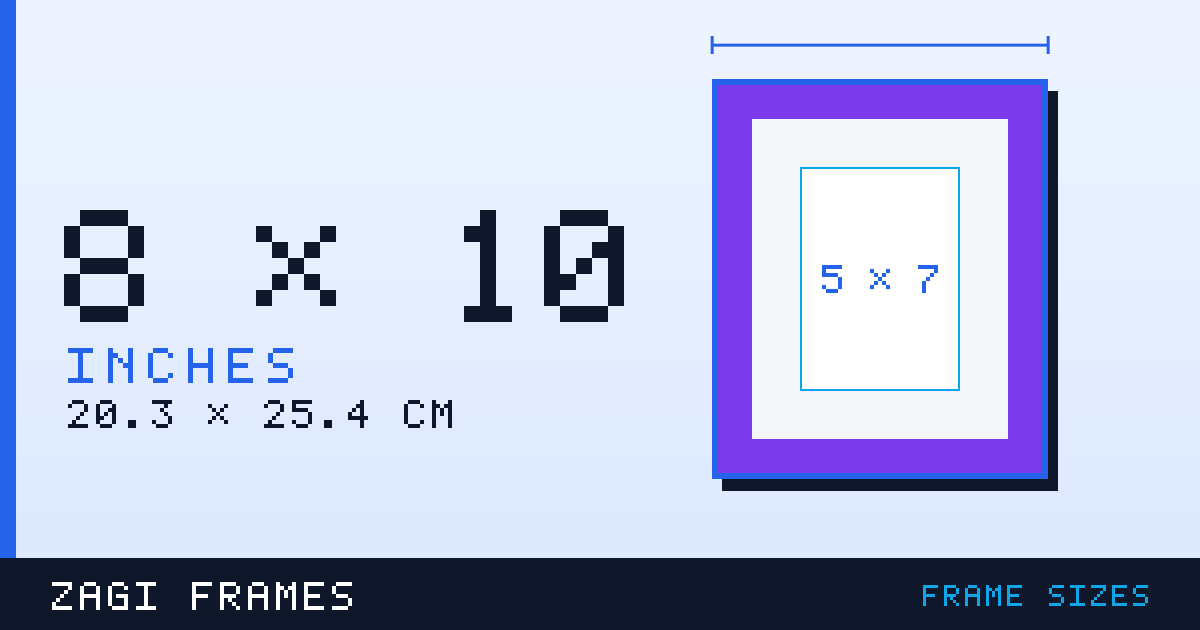
Opening: 8 x 10 inches, 20.3 x 25.4 cm, 80 square inches.
Aspect ratio: 4:5 (1:1.25).
Outside dimensions:
| Moulding width | Outside size |
|---|---|
| 0.5" | 9 x 11 |
| 0.75" | 9.5 x 11.5 |
| 1.25" | 10.5 x 12.5 |
| 2" | 12 x 14 |
Weight: roughly 1 to 2 lb with glass, under 1 lb with acrylic. Any picture hook holds one. This is the one size where adhesive hanging strips are genuinely adequate, though they will still eventually release in a hot room.
Where 4:5 comes from, and why it matters
8x10 is not an arbitrary size. It is the exact dimension of a sheet of 8x10 large-format film, the format American portrait studios used for the better part of a century. The print size followed the negative, and the frame size followed the print.
The consequence is that 8x10 is the shape of a technology that essentially no longer exists. Modern cameras produce 3:2 files; phones produce 4:3. Neither is 4:5.
Printing a 3:2 photo to fill an 8x10 removes about 17% of the long edge — roughly 1.3 inches of a 12-inch-wide image, taken from one or both ends. On a landscape that is scenery. On a group portrait it is a person.
If you want your photographs uncropped, the 3:2 equivalent of 8x10 is 8x12, which is much less widely stocked but exists. If you want to keep the 8x10 frame, mat the photo and let the mat cover the mismatch.
What actually fits
An 8x10 print, unmatted. The obvious case. Fine for studio portraits, which were composed for the shape.
A 5x7 behind a mat. The standard matted combination. An 8x10 mat with a 5x7 opening leaves about 1.5 inches of border and turns a small print into something with presence.
A 4x6 behind a mat. A wider border — around 2 inches — which suits a snapshot better than a tight 5x7 opening does. This is a good way to make an ordinary photo look deliberate.
Not an 8.5x11 document. Letter paper is half an inch wider and an inch taller. It does not fit and should not be trimmed. Use an 8.5x11 frame or, better, an 11x14 frame with an 8.5x11 mat opening.
The wall problem
An 8x10 frame hung alone on a wall of any size reads as small. This is not a matter of taste; it is a proportion problem. A 10x12 outside dimension against an eight-foot wall occupies about 1% of the visible surface, and the eye reads it as an accessory rather than a picture.
Three ways round it:
Mat it up. Put the 8x10 print in an 11x14 or 12x16 frame with a mat. The image is the same size; the object is half again as large and reads properly on a wall.
Group it. Three or more 8x10s in a row, in matching frames, with two to three inches between them, become a single visual element. Consistency matters more than the individual size — see the gallery wall guide.
Put it on a surface. 8x10 is an excellent shelf, mantel and desk size, where it is viewed from three feet rather than ten.
Buying an 8x10
The size is so heavily commoditised that the quality range runs from genuinely good to actively bad. Things that separate them:
Glazing. The cheapest 8x10 frames use thin styrene that scratches during the first dusting. Glass or true acrylic is worth the small premium and is usually detectable by weight.
Backing. Look for hardboard or thick card, not thin corrugated board. Thin backing lets a print bow into the glazing.
The mat, if included. Frames sold "8x10 matted to 5x7" often include a very thin mat with a shallow, ragged bevel. A separately bought 4-ply mat costs a few dollars and looks substantially better.
Hanging hardware. Most 8x10 frames ship with a sawtooth hanger and a fold-out easel back so they can stand or hang. That dual function is genuinely useful at this size.
Multi-aperture 8x10 frames
A common variant holds two, three or four smaller photos behind a single 8x10 mat with multiple openings. These work when the photos are related — a sequence, a set of siblings, one event — and look cluttered when they are not.
The practical limit is three openings in an 8x10. Four openings leave borders too narrow to read as intentional, and the individual images end up around 2.5 x 3.5 inches, which is wallet size.
When 8x10 is the right answer
Despite the reservations above, there are cases where it is exactly right:
- Studio portraits, which were composed for 4:5
- Desk and shelf display, where the viewing distance is short
- Grids of three or more, where the individual size stops mattering
- Certificates and awards sized 8x10 rather than letter
- Anywhere you want a print with genuinely universal availability of mats, glass and replacements
And one case where it is not: as a standalone wall piece in a room of any size. For that, buy the 11x14 and mat down.
Resolution and printing
An 8x10 at 300 DPI needs 2400 x 3000 pixels — 7.2 megapixels. Every phone and camera made in the last fifteen years clears that comfortably, which is one reason 8x10 remains the default enlargement.
The catch is not resolution but cropping. Because the frame is 4:5 and your file is almost certainly 3:2 or 4:3, the print service has to remove material. Most default to a centre crop, which is rarely the right crop.
Two ways to keep control: crop the file yourself to 4:5 before uploading, so you decide what leaves; or order the print at "fit" rather than "fill", which prints the whole image with white borders that a mat then covers.
Multi-aperture and collage 8x10s
A common variant holds two, three or four smaller photos behind a single 8x10 mat with multiple openings.
These work when the photos are genuinely related — a sequence, a set of siblings, one event — and look cluttered when they are not. The practical limit is three openings. At four, the individual images drop to around 2.5 x 3.5 inches, which is wallet size, and the mat borders between them become too narrow to read as deliberate.
Cost and where to buy
8x10 is the most commoditised frame size there is, which means the price range is enormous and correlates only loosely with quality. A general-retail 8x10 and a good one from an online framer can differ by a factor of five, and the difference is in glazing, backing rigidity and corner joints rather than in anything visible in a listing photograph.
If you are buying several for a grid, order them together from one source. Nominally identical frames from different production runs differ subtly in finish, and at 8x10 they will be hanging inches apart. Where to buy picture frames covers the trade-offs between sources.
10 questions
Frequently asked questions
How big is an 8x10 frame?
What size photo fits an 8x10 frame?
Is 8x10 a standard frame size?
What is the aspect ratio of 8x10?
Can I put an 8.5x11 document in an 8x10 frame?
What size mat fits an 8x10 frame?
Is 8x10 too small to hang on a wall?
What frame size do I need for an 8x10 print with a mat?
How heavy is an 8x10 frame?
Why do school photos come in 8x10?
Related guides
- The 11x14 frame, measured properlyWhat an 11x14 frame actually holds, the mat openings that turn it into an 8x10 or 8.5x11 display, and how to buy one that fits.
- 5x7 picture framesThe 5x7 frame is the desk and shelf standard. Here is what fits it, the mat that drops a 4x6 inside, and how to group them well.
- Picture frame mats and mat sizesHow a mat is measured, the overlap that stops a print falling through, standard mat openings by frame size, and custom mat maths.
- What size frame do I need?Measure the artwork, decide on a mat, then pick the frame — with a lookup table for every common print size, matted and unmatted.