The 20x30 frame
A 20x30 frame fits a 2:3 enlargement edge to edge. Here are the mat options, weight limits and hanging hardware a frame that size needs.
Contents · 8 sections
20x30 is the largest frame size that is still unambiguously about photography. It is exactly 2:3, exactly five times a 4x6 print, and the standard size photo labs offer at the top of their enlargement range.
The numbers
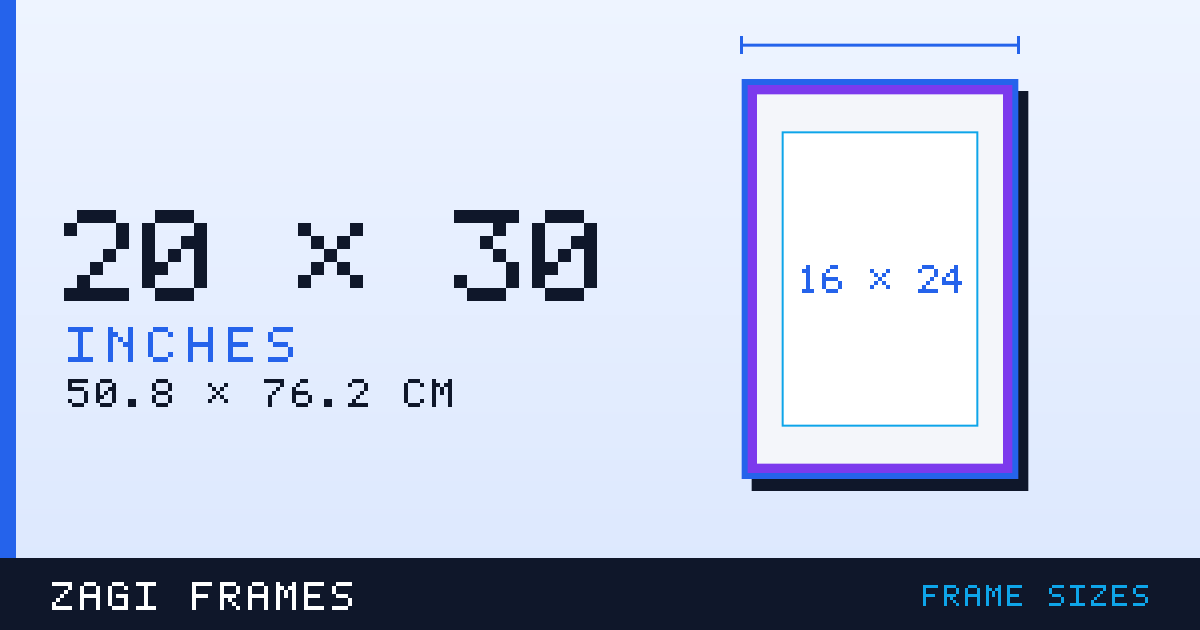
Opening: 20 x 30 inches, 50.8 x 76.2 cm, 600 square inches.
Aspect ratio: 2:3, shared with 4x6, 8x12, 12x18, 16x24 and 24x36.
Outside dimensions:
| Moulding width | Outside size |
|---|---|
| 0.75" | 21.5 x 31.5 |
| 1.25" | 22.5 x 32.5 |
| 2" | 24 x 34 |
| 3" | 26 x 36 |
Weight, assembled:
| Build | Weight |
|---|---|
| Aluminium, acrylic | 4 — 5 lb |
| Wood, acrylic | 5 — 6 lb |
| Wood, 2mm glass | 8 — 10 lb |
| Wide wood, glass, mat | 12 — 15 lb |
A 20x30 sheet of 2mm float glass weighs about 4.8 pounds on its own. That is the single biggest variable in the table and the main argument for acrylic.
Why photographers like this size
Every dimension in the 2:3 family is a straight multiple of 4x6:
| Multiple of 4x6 | |
|---|---|
| 4x6 | 1x |
| 8x12 | 2x |
| 12x18 | 3x |
| 16x24 | 4x |
| 20x30 | 5x |
| 24x36 | 6x |
That means a single file, composed once, works at every size with no crop decision at any step. If you print the same image at several sizes for different rooms — a common thing to want — the 2:3 family is the only one that lets you do it without recomposing.
The resolution question at 20x30 is real but manageable. A true 300 DPI print needs 6000 x 9000 pixels, which is 54 megapixels — more than most cameras. At 200 DPI you need 4000 x 6000, which is 24 megapixels and entirely ordinary. A 20x30 hung on a wall and viewed from six feet is perfectly sharp at 200 DPI. Check your own file against the target in the aspect ratio calculator.
Availability, honestly
20x30 is a genuine standard size and it is not always on a shelf. General retailers carry 18x24 and 24x36 and frequently skip everything between.
Where it is reliably available:
- Photo labs and print services, which offer it as a standard enlargement
- Online frame retailers, in a full range of finishes
- Framing shops, as a stock chop size
- Art supply retailers, in basic profiles
If you are choosing a print size and you care about being able to buy a frame locally at short notice, that is a genuine reason to consider 24x36 instead. If you are ordering online anyway, the constraint disappears.
Matting at 20x30
Down to 16x24. A 20x30 mat with a 16x24 opening gives a two-inch border. Both sizes are 2:3, so the artwork and the mat opening share a shape and the result looks entirely natural.
Down to 12x18. A much wider border — four inches at the sides, six top and bottom. This is a formal, gallery-style presentation that suits a smaller, denser image. It also makes a 12x18 print occupy 20x30 of wall, which is sometimes exactly the goal.
Up to 24x36. To mat a 20x30 print, buy a 24x36 frame with a 20x30 opening. This is one of the easiest step-ups in framing because both sizes are common and the two-inch border it produces is the conventional proportion.
Glazing and hanging
At 20x30 the glazing decision has real consequences.
Acrylic is the default recommendation. It saves about three and a half pounds, does not shatter, and is easier to handle during assembly — a 20x30 glass sheet flexes noticeably when held at the edges, which is unnerving and occasionally fatal to the glass.
Glass remains reasonable for an original work in a stable location with a solid fixing, where the improved scratch resistance is worth having.
For hanging:
- Two fixings, spaced roughly ten inches either side of centre
- Rated at least double the assembled weight, each
- D-rings and wire rather than a sawtooth, so it can be levelled
- Centre of image at 57 to 60 inches from the floor
- Felt bumpers at the bottom rear corners
For a portrait-orientation 20x30 the top edge lands around 75 inches, which clears most furniture but is worth checking against low ceilings and sloped walls.
The metric near-miss
50x70 cm is the European equivalent size and it is not the same thing. 50x70 cm converts to 19.7 x 27.6 inches — a third of an inch narrower and nearly two and a half inches shorter than 20x30.
A 50x70 print in a 20x30 frame therefore floats, badly, in the vertical direction. The gap is large enough to be obviously wrong rather than merely imprecise.
If you have bought a print from a European seller, check which system it was printed in before buying a frame. The metric frame sizes guide covers all the near-misses between the two systems.
Matting maths at this size
Because 20x30 is 2:3, its matting behaves predictably. A mat with an opening in the same ratio produces a border that is proportionally even, and one in a different ratio does not.
| Mat opening | Ratio | Side border | Top/bottom border |
|---|---|---|---|
| 16x24 | 2:3 | 2" | 3" |
| 12x18 | 2:3 | 4" | 6" |
| 16x20 | 4:5 | 2" | 5" |
| 18x24 | 3:4 | 1" | 3" |
The first two look balanced because the opening and the frame share a shape — the border is wider top and bottom in absolute terms but proportionally identical, which reads as even. The last two look progressively less deliberate.
This is the practical argument for matching mat openings to frame ratios wherever possible, and it applies at every size.
Buying and building
Because 20x30 is not always on a shelf, it is one of the sizes where building your own becomes genuinely attractive.
The material requirement, in 2-inch moulding: 2 × (20 + 30) + 8 × 2 = 116 inches, plus waste, so a single 10-foot stick just about covers it with nothing to spare. Buy two, or use a 1.5-inch moulding and fit it comfortably into one.
The saw needs to handle a 30-inch cut accurately, which means a mitre saw with proper stock support rather than one balanced on a bench. Everything else is the same process as any smaller frame — see the step-by-step build.
If you are buying rather than building, check three things: that the rabbet is deep enough for glazing plus mat plus backing, that the backing supplied is rigid rather than corrugated card, and what hanging hardware comes in the box. Many frames at this size ship with a single sawtooth, which is inadequate for a 20-inch-wide frame.
10 questions
Frequently asked questions
How big is a 20x30 frame?
What fits in a 20x30 frame?
Is 20x30 a standard frame size?
What is the aspect ratio of 20x30?
How heavy is a 20x30 frame?
What size mat goes in a 20x30 frame?
What frame do I need for a 20x30 print with a mat?
Does a 20x30 frame need a stud?
Is 20x30 the same as 50x70 cm?
Why is 20x30 popular for photo enlargements?
Related guides
- The 24x36 frame24x36 is the default large poster size. Weight, glazing, moulding width and the hanging hardware a frame that big genuinely needs.
- Poster frame sizes and what they fitStandard poster frame sizes from 11x17 to 27x40, the odd sizes posters actually ship in, and how to frame a poster without trimming it.
- How to hang a picture frameHanging height, hardware by weight, drywall versus plaster, and the paper-template method that gets a gallery wall right the first time.
- Picture frame glass and acrylic glazingStandard, non-glare, UV and museum glass compared with acrylic on price, weight, clarity and protection — and when each one is the right call.