The 18x24 frame
18x24 is the small poster standard and a 3:4 art size. Mat options, moulding width, glazing choice and hanging hardware for an 18x24 frame.
Contents · 9 sections
18x24 is the size that finally reads as a picture rather than a photograph. It is the standard small poster in North America, a clean 3:4 art shape, and — unusually for a poster size — stocked in ordinary shops.
The numbers
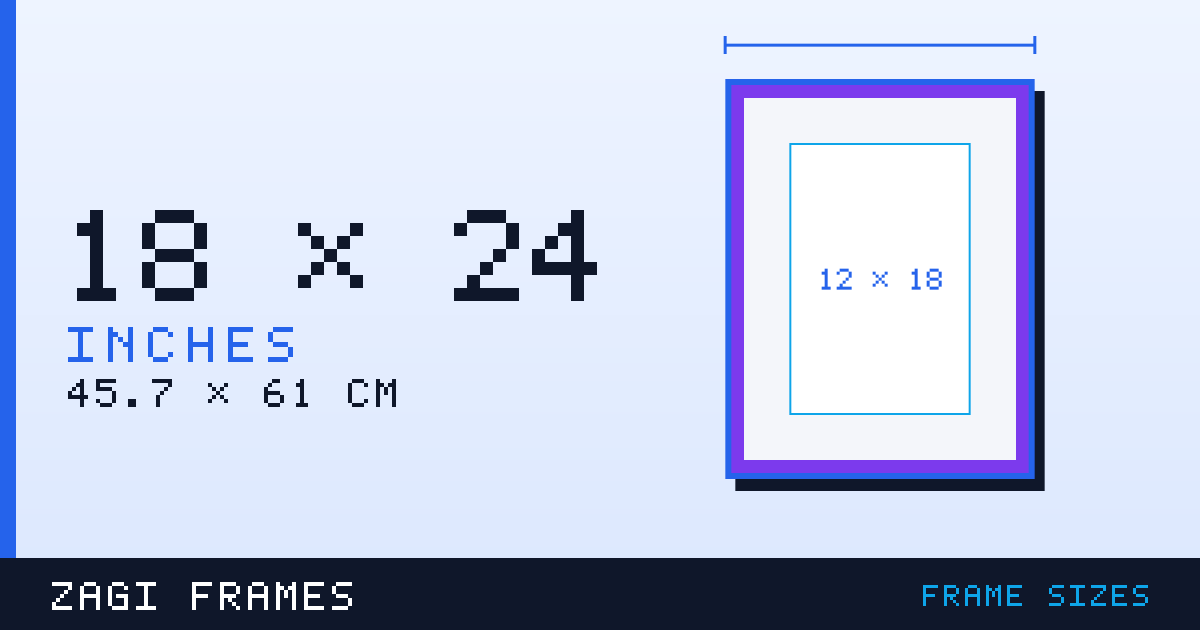
Opening: 18 x 24 inches, 45.7 x 61 cm, 432 square inches.
Aspect ratio: 3:4 (1:1.333), shared with 9x12, 12x16 and 30x40.
Outside dimensions:
| Moulding width | Outside size |
|---|---|
| 0.75" | 19.5 x 25.5 |
| 1.25" | 20.5 x 26.5 |
| 2" | 22 x 28 |
| 3" | 24 x 30 |
Weight, assembled:
| Build | Weight |
|---|---|
| Aluminium, acrylic | 3 — 4 lb |
| Wood, acrylic | 3.5 — 5 lb |
| Wood, 2mm glass | 5.5 — 8 lb |
| Wide wood, glass, mat | 9 — 11 lb |
This is the threshold where a single nail stops being adequate. Two hooks rated for 25 pounds each, spaced about six inches either side of centre, is the sensible minimum.
Why 3:4 is useful
18x24's ratio matches the default output of most phone cameras, which is 4:3. That is genuinely convenient: a photo taken on a phone, printed at 18x24, fits with no cropping at all.
It also matches standard art paper — 9x12 pads, and the 12x16 and 18x24 sheets sold for drawing and watercolour. Anyone framing their own work on paper is very likely already working in this family.
What it does not match is a camera file. A 3:2 photograph printed to fill an 18x24 loses about 11% of its long edge. Less brutal than the 17% an 8x10 costs, but still visible. The 3:2 equivalent at this scale is 16x24 or 20x30.
What fits
An 18x24 poster, unmatted. The primary use. Note that commercially printed posters advertised as 18x24 are sometimes a fraction under — measure before assuming.
A 12x18 print behind a mat. The standard matted combination, giving a three-inch border. This is a strong presentation: 12x18 is a 3:2 size, so a camera photo fits it exactly, and the mat handles the shape change to the 3:4 frame.
A 16x20 print behind a mat. Technically possible, but the resulting one-inch border is too narrow to read as a design decision. Use a 20x24 frame instead.
An A2 sheet with a custom mat. A2 is 16.5 x 23.4 inches. Placed bare in an 18x24 frame it floats with a visible gap. A custom mat cut to A2 fixes it completely and costs less than a custom frame.
The poster question
18x24 is where most people first frame a poster properly, and there are two decisions that matter.
Do not trim the poster. If it is slightly oversized, the frame is wrong. Trimming is irreversible and always visible along the cut edge.
Let a rolled poster flatten first. Unroll it, lay it under weight with clean paper above and below, and leave it a day or two. A poster forced into a frame while still curled will press its centre against the glazing permanently.
Beyond that, an 18x24 poster in a frame with a mat stops looking like a poster and starts looking like a print — which is usually the point of framing it at all.
Glass versus acrylic here
18x24 sits right at the crossover. A 2mm glass sheet at this size weighs about 3.5 pounds; the acrylic equivalent about 1.4.
Glass is defensible: the weight is still manageable, and the scratch resistance matters on a frame that gets dusted. Acrylic is defensible: it halves the load on the fixing, and it does not produce large sharp fragments if the frame comes down.
The deciding factors are usually location and contents. Above a bed, a sofa or a child's play area, use acrylic. For an original work in a stable spot with a solid fixing, glass is fine and slightly clearer. For posters specifically, acrylic — a poster is reproducible and the weight saving is not.
Hanging one
The practical differences from smaller frames:
Two fixings, not one. An 18x24 on a single hook will rotate off level every time someone closes a door nearby.
Wire, not sawtooth. Fit D-rings about a third of the way down each side and run wire between them with a couple of inches of slack. This lets you slide the frame horizontally to centre it after hanging, which a sawtooth does not.
Height. Centre of image at 57 to 60 inches from the floor. For a portrait-orientation 18x24 that puts the top edge around 71 inches.
Bumpers. Felt pads on the bottom rear corners hold the frame parallel to the wall and stop it marking paint.
Full details on fixings by weight are in the hanging guide.
Buying at 18x24
Check the actual internal size. Frames sold as "18x24 poster frames" occasionally have a rabbet cut tight to exactly 18x24 with no clearance, which makes loading a poster genuinely difficult. A frame with an eighth of an inch of play is easier to live with.
Look at the backing. An 18x24 sheet of thin card bows noticeably under its own weight. Hardboard or thick foam board is what you want.
Consider a snap frame if the content changes. If you swap posters seasonally, an aluminium snap frame changes them in seconds and never needs dismantling. It looks commercial, which is either a problem or exactly right depending on the room.
Buy the mat separately. Ready-made 18x24 frames rarely include a good mat. A 4-ply acid-free mat with a 12x18 opening, bought separately, transforms the result for a few dollars.
Resolution at 18x24
A 300 DPI print at this size needs 5400 x 7200 pixels — 38.9 megapixels, which is beyond most cameras.
At 200 DPI, which is entirely adequate for something hung on a wall and viewed from four feet or more, the requirement is 3600 x 4800, or 17.3 megapixels. That is within reach of most recent cameras and many phones.
The number worth checking is your file's actual pixel dimensions after any cropping, rather than the camera's headline megapixel figure. The aspect ratio calculator reports the target for any size you enter.
Cost, relatively
For the same 18x24 piece across the common routes:
| Approach | Relative cost |
|---|---|
| Retail poster frame, no mat | 1x |
| Retail frame plus custom-cut mat | 2.5 — 3x |
| Better online frame plus custom mat | 4 — 5x |
| Full custom framing | 8 — 12x |
The middle rows are the value. A custom mat inside an ordinary 18x24 frame turns a poster into something that reads as framed art, for a fraction of what a framing shop charges.
10 questions
Frequently asked questions
How big is an 18x24 frame?
What fits in an 18x24 frame?
Is 18x24 a standard poster size?
What is the aspect ratio of 18x24?
What size mat goes in an 18x24 frame?
Should an 18x24 frame use glass or acrylic?
How heavy is an 18x24 frame?
What size frame do I need for an 18x24 print with a mat?
Does an A2 poster fit an 18x24 frame?
Is 18x24 too big for a bedroom wall?
Related guides
- The 24x36 frame24x36 is the default large poster size. Weight, glazing, moulding width and the hanging hardware a frame that big genuinely needs.
- Poster frame sizes and what they fitStandard poster frame sizes from 11x17 to 27x40, the odd sizes posters actually ship in, and how to frame a poster without trimming it.
- Picture frame moulding explainedRabbet depth, face width, profiles and lineal-foot pricing — how to read a moulding spec and buy the right length for your frame.
- The 20x30 frameA 20x30 frame fits a 2:3 enlargement edge to edge. Here are the mat options, weight limits and hanging hardware a frame that size needs.