The 12x18 frame
12x18 is a true 2:3 frame size, which makes it perfect for DSLR photos and awkward for everything else. Here is what fits and what does not.
Contents · 9 sections
12x18 is the frame size that photography wants and retail does not stock. It is exactly 2:3 — three times a 4x6 print in each direction — which makes it the smallest large-ish frame that takes a camera photograph without cropping a thing.
The numbers
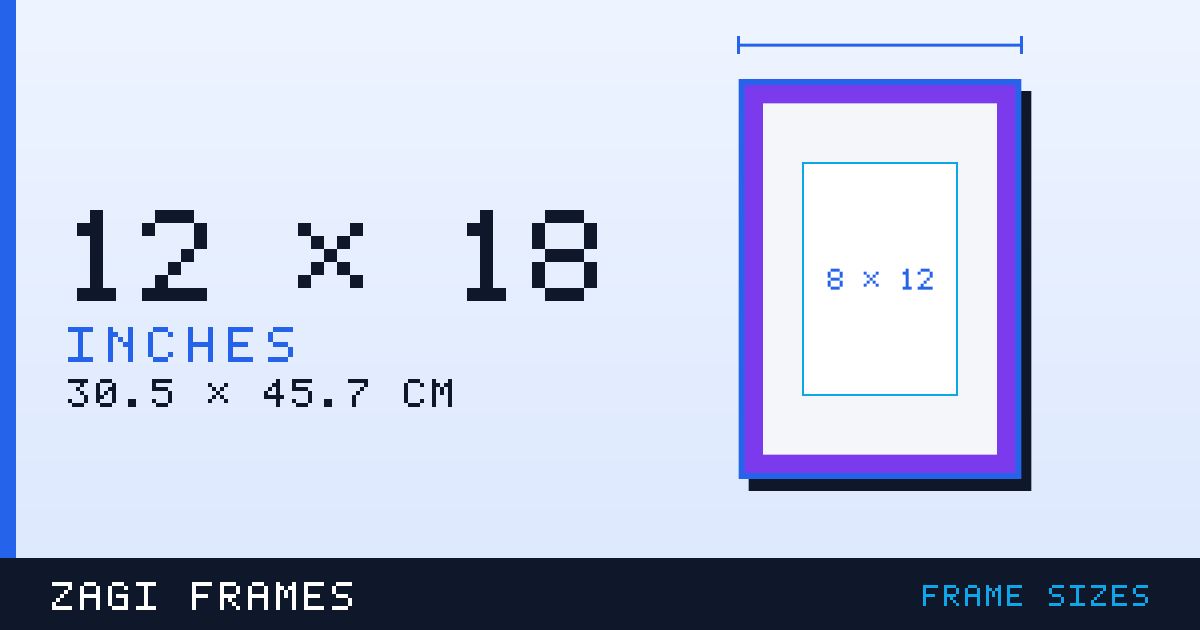
Opening: 12 x 18 inches, 30.5 x 45.7 cm, 216 square inches.
Aspect ratio: 2:3, shared with 4x6, 8x12, 16x24, 20x30 and 24x36.
Outside dimensions:
| Moulding width | Outside size |
|---|---|
| 0.75" | 13.5 x 19.5 |
| 1.25" | 14.5 x 20.5 |
| 2" | 16 x 22 |
Weight: 3 to 4 lb with glass, 2 to 3 lb with acrylic. Light enough for a single hook, though two keep it level.
Why the size exists at all
Every standard photo print size in the 2:3 family is a whole multiple of 4x6:
| Multiple | |
|---|---|
| 4x6 | 1x |
| 8x12 | 2x |
| 12x18 | 3x |
| 16x24 | 4x |
| 20x30 | 5x |
| 24x36 | 6x |
12x18 is the 3x step, and it sits in a useful gap: bigger than the 8x10-and-11x14 range that dominates shelves, smaller than the poster sizes that demand real wall commitment.
Photo labs offer it because it is honest. A lab that offers only 8x10 and 16x20 is quietly cropping 17% off every customer's long edge. Offering 12x18 lets a 3:2 file print as shot.
The stocking problem
Here is the awkward part. 12x18 is a genuine standard size and general retailers largely ignore it.
Walk into a supermarket, a pharmacy or a general homewares shop and you will find 8x10, 11x14, 16x20, 18x24 and 24x36. You will very rarely find 12x18. The reason is shelf economics rather than anything about the size: the shelf goes to what turns over fastest, and the sizes people are handed by portrait studios turn over fastest.
Where you will find it:
- Online frame retailers, in a full range of finishes
- Framing suppliers, as a stock chop
- Photo labs that sell framed prints
- Art supply retailers, in basic profiles
None of that is difficult; it just means you cannot buy the frame on the way home. If same-day availability matters, print at 11x14 and accept the crop, or go up to 18x24 and mat the 12x18 inside it.
What fits
A 12x18 print, unmatted. The primary use, and a good one — the print fills the frame and the shape is right for a camera file.
An 8x12 print behind a mat. A 12x18 mat with an 8x12 opening gives two inches at the sides and three top and bottom. Both sizes are 2:3, so the opening and the frame share a shape and the border reads as even even though it is not.
An A3 sheet with a custom mat. A3 is 11.7 x 16.5 inches. Bare in a 12x18 frame it is loose by a third of an inch horizontally and an inch and a half vertically — a gap large enough to look like a mistake. Cut a mat to A3 and the problem disappears entirely.
A 9x12 print, with reservations. It fits behind a mat, but 9x12 is 3:4 and the frame is 2:3, so the border ends up much wider top and bottom than at the sides. Some people like the effect; most find it unbalanced. A 12x16 frame is the better home for a 9x12.
Going up a size
To mat a 12x18 print, the standard answer is an 18x24 frame with a 12x18 mat opening. That gives a three-inch border and is an excellent pairing for two reasons: the proportions work, and 18x24 is one of the most widely stocked sizes there is.
That combination — buy the awkward size as a mat opening rather than as a frame — is a good general strategy. Mats are cut to order cheaply; frames in unusual sizes are not.
Buying notes
Check the ratio is right. Some listings describe 12x18 frames as "A3 frames", which they are not. A3 is 11.7 x 16.5. If a listing gives both, believe the inches.
Glazing. At this size either glass or acrylic is fine. Glass weighs about 1.7 pounds; the frame is light enough that it does not matter.
Hanging hardware. Sawtooth hangers are common at this size and lock you into one orientation. If you might ever want to hang it the other way round, fit D-rings.
Depth. If you plan to mat down to 8x12, check the rabbet is at least three eighths of an inch deep. Thin decorative profiles often are not.
Resolution at 12x18
A true 300 DPI print at this size needs 3600 x 5400 pixels, which is 19.4 megapixels. That is comfortably within reach of any camera made in the last decade and beyond most phones at their native resolution.
At 200 DPI — perfectly acceptable for a print viewed from four feet or more — the requirement drops to 2400 x 3600, or 8.6 megapixels. Almost any modern file will do.
The number worth checking is your file's actual pixel dimensions rather than its megapixel rating, because a heavily cropped 24-megapixel file can easily be under 10 megapixels by the time it reaches the printer. The aspect ratio calculator reports the pixel target for any size you enter.
12x18 versus the alternatives
If 12x18 turns out to be inconvenient, three sizes sit nearby and each trades something.
11x14 is stocked everywhere and is 1:1.27 rather than 2:3. A 3:2 photo printed to fill an 11x14 loses about 15% of its long edge. You gain immediate availability and lose part of the image.
12x16 is 3:4 and shares the 12-inch width. A 3:2 photo loses about 11% here. It suits art paper and phone photos better than camera files.
16x24 is the next step up in the same 2:3 family and needs noticeably more wall. It is also harder to find than 12x18, so it solves availability by making it worse.
There is no size that is both 2:3 and universally stocked below 24x36. That is simply a gap in what retail carries, and the honest options are to order online, to mat up into an 18x24, or to accept a crop.
Orientation and hanging
Nothing about a 12x18 frame favours portrait or landscape, but the hardware often does. Frames at this size frequently ship with a single sawtooth hanger fixed to one edge, which locks the orientation permanently.
If you might want to rotate the frame later — and with a 2:3 photograph you very well might — fit D-rings to both pairs of sides and use wire. It takes five minutes with a bradawl and a screwdriver, costs almost nothing, and makes the frame reusable for whatever comes next.
At 3 to 4 pounds a 12x18 hangs from a single hook rated for 20 pounds without concern, though two hooks keep it level against door slams and passing traffic. Felt bumpers on the bottom rear corners are worth adding regardless.
10 questions
Frequently asked questions
Is 12x18 a standard frame size?
What fits in a 12x18 frame?
What is the aspect ratio of 12x18?
Does an A3 poster fit a 12x18 frame?
What size mat goes in a 12x18 frame?
What frame do I need for a 12x18 print with a mat?
Why do photo labs offer 12x18?
How heavy is a 12x18 frame?
Is 12x18 the same as 12x16?
Can I use a 12x18 frame in landscape orientation?
Related guides
- Aspect ratio and frame sizesWhy a 4:3 photo will not fit an 8x10 frame, which frame sizes share a ratio, and how to resize a print without losing someone's head.
- The 24x36 frame24x36 is the default large poster size. Weight, glazing, moulding width and the hanging hardware a frame that big genuinely needs.
- Standard picture frame sizes explainedEvery standard picture frame size in inches and centimetres, which print each one fits, and how matting changes the frame size you need to buy.
- Frame size chartA printable frame size chart pairing every common frame with its photo, poster and art print size in both inches and centimetres.