The 16x20 frame
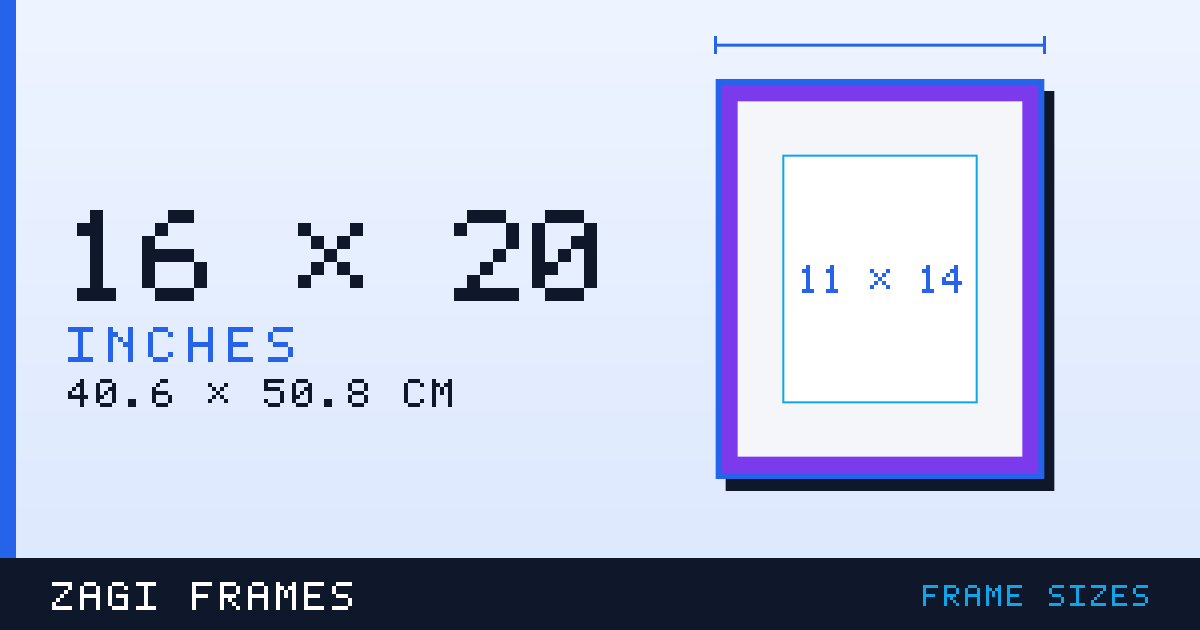
16x20 is the most useful mid-size frame there is: it takes an 11x14 mat, a 12x16 print or a full-bleed 16x20 canvas. Here are the numbers.
Contents · 9 sections
16x20 is the most useful frame size in the standard range. It takes a 16x20 print at full bleed, an 11x14 behind a generous mat, a 12x16 behind a modest one, or a 16x20 canvas in a floater. That flexibility, combined with universal availability, makes it the size to reach for when you are not sure.
The numbers
Opening: 16 x 20 inches, 40.6 x 50.8 cm, 320 square inches — exactly four times the area of an 8x10.
Aspect ratio: 4:5, identical to 8x10 and 24x30.
Outside dimensions:
| Moulding width | Outside size |
|---|---|
| 0.75" | 17.5 x 21.5 |
| 1.25" | 18.5 x 22.5 |
| 2" | 20 x 24 |
| 3" | 22 x 26 |
Weight, assembled:
| Build | Weight |
|---|---|
| Aluminium, acrylic | 2 — 3 lb |
| Wood, acrylic | 3 — 4 lb |
| Wood, 2mm glass | 4.5 — 6 lb |
| Wide wood, glass, double mat | 7 — 9 lb |
At the top of that range a single small nail is not sufficient. Use a hook rated for at least 25 pounds, and preferably two of them so the frame cannot rotate.
The three ways to use it
Full-bleed 16x20
The print fills the opening. Suits canvases, posters, and photographic prints where the composition runs to the edges. This is also the standard size for stretched canvases, which is worth knowing if you are pairing a frame with painting supplies.
Matted to 11x14
The most common combination in the size. A 16x20 mat with an 11x14 opening gives about 2.5 inches of border at the sides and slightly more at the bottom on a weighted mat. That is generous enough to look like a gallery presentation rather than a compromise.
This pairing is why 11x14 and 16x20 are both stocked so heavily: they are the two ends of the same relationship.
Matted to 12x16
A narrower two-inch border, which suits larger or busier images that would be crowded by a 2.5-inch mat. Less commonly available ready-made than the 11x14 version, but any framer will cut it.
The 4:5 constraint
16x20 shares 8x10's ratio and therefore shares its problem: it does not match a camera file.
A 3:2 photograph printed to fill a 16x20 loses about 17% of the long edge — around 3.4 inches of a 20-inch-wide image. That is a significant crop and one you should make deliberately rather than let a print lab make for you.
The workarounds are the usual three. Print at 16x24 instead, which is 3:2 and fits the image exactly. Crop consciously to 4:5 in software, choosing what leaves. Or print at "fit" with borders and cover them with a mat cut to the image's own ratio — which is why a 16:9 panorama can live perfectly happily inside a 16x20 frame.
Run your file's dimensions through the aspect ratio calculator before ordering anything at this size; a mis-sized 16x20 print is a real cost, not a rounding error.
Framing a canvas at 16x20
16x20 is one of the most common stretched-canvas sizes, and framing one is not the same job as framing a print.
A standard 16x20 frame has a rabbet of a quarter to three eighths of an inch. A stretched canvas is three quarters of an inch deep on thin bars, and an inch and a half on gallery-depth ones. It will not go in.
The correct solution is a floater frame: a deep, open-backed frame that the canvas is screwed into from behind, sitting inside it with a deliberate quarter-inch gap all round. It reads as intentional, adds no glazing, and is the standard way canvases are framed.
The wrong solution, which is nevertheless common, is to buy a conventional frame and remove the glazing and backing to make room. The canvas then sits proud of the frame face, which looks like exactly what it is.
Buying at 16x20
The size is common enough to be cheap and large enough that corners matter. What to check:
Corner joinery. At 16x20 a glued-only mitre in a soft moulding will open within a couple of years. V-nailed or splined corners hold.
Backing rigidity. A 16x20 sheet of thin card bows visibly. Hardboard or thick foam board keeps the print flat against the mat.
Glazing type. Both glass and acrylic are reasonable here. If the frame is unexpectedly light for its size and the glazing flexes, it is styrene — worth replacing.
Hanging hardware. Many 16x20 frames still ship with a single sawtooth. Fit D-rings and wire; it takes five minutes and makes the frame levellable for the rest of its life.
Depth for matting. If you plan a double mat, check the rabbet is at least three eighths of an inch. Slim decorative profiles at this size often are not.
Going larger from 16x20
If you want a 16x20 print matted, the next steps are 20x24 for a two-inch border or 22x28 for three. Both are genuine standard sizes; neither is stocked in general retail, so expect to order. Beyond that, large picture frames covers the weight and fixing questions that start to dominate above 24x36.
Resolution at 16x20
A 300 DPI print at 16x20 needs 4800 x 6000 pixels — 28.8 megapixels. That is more than most cameras deliver, and more than any phone delivers at native resolution.
In practice you do not need it. A 16x20 hung on a wall is viewed from four to six feet, at which 200 DPI is indistinguishable from 300. That drops the requirement to 3200 x 4000, or 12.8 megapixels, which almost any recent file satisfies.
The figure to be wary of is heavy cropping. A 24-megapixel file cropped to a third of its area is an 8-megapixel file, and printing that at 16x20 gives about 150 DPI — acceptable at a distance, visibly soft up close.
What a 16x20 costs to frame
Relative pricing for the same 16x20 piece, which is more durable information than absolute figures:
| Approach | Relative cost |
|---|---|
| General retail frame, no mat | 1x |
| Retail frame plus ready-made mat | 1.5x |
| Retail frame plus custom-cut mat | 2 — 3x |
| Better online frame plus custom mat | 3 — 5x |
| Full custom framing | 8 — 12x |
| Full custom with conservation glazing | 15 — 25x |
The second and third rows are where the value is. A custom-cut mat inside an ordinary frame accounts for most of what makes a framed piece look professional, at a small fraction of full-service cost. Where to buy picture frames covers the sources in detail.
Hanging a 16x20
At 4 to 6 pounds this is the size where hanging hardware starts to matter.
- Two hooks rated 25 pounds each, spaced about five inches either side of centre. One hook lets a 16-inch-wide frame rotate every time a door closes.
- D-rings and wire rather than a sawtooth, so the frame can be nudged horizontally after hanging.
- Centre of image at 57 to 60 inches from the floor.
- Felt bumpers on the bottom rear corners.
Above a sofa or sideboard, leave 6 to 10 inches between the furniture top and the frame's bottom edge.
10 questions
Frequently asked questions
How big is a 16x20 frame?
What size print fits a 16x20 frame?
Is 16x20 a standard frame size?
What is the aspect ratio of 16x20?
What size mat do I need for a 16x20 frame?
Should a 16x20 frame use glass or acrylic?
How heavy is a 16x20 frame?
Can I frame a 16x20 canvas?
What frame do I need for a 16x20 print with a mat?
Why is 16x20 such a common frame size?
Related guides
- The 11x14 frame, measured properlyWhat an 11x14 frame actually holds, the mat openings that turn it into an 8x10 or 8.5x11 display, and how to buy one that fits.
- Picture frame mats and mat sizesHow a mat is measured, the overlap that stops a print falling through, standard mat openings by frame size, and custom mat maths.
- The 18x24 frame18x24 is the small poster standard and a 3:4 art size. Mat options, moulding width, glazing choice and hanging hardware for an 18x24 frame.
- Float frames and floater framesA float frame suspends paper between glass; a floater frame surrounds a canvas with a gap. They are not the same thing — here is how to use each.