5x7 picture frames
The 5x7 frame is the desk and shelf standard. Here is what fits it, the mat that drops a 4x6 inside, and how to group them well.
Contents · 9 sections
5x7 is the small frame that does real work. It is the standard shelf and desk size, the default for table numbers and place settings, and the smallest print that reads properly at conversational distance.
The numbers
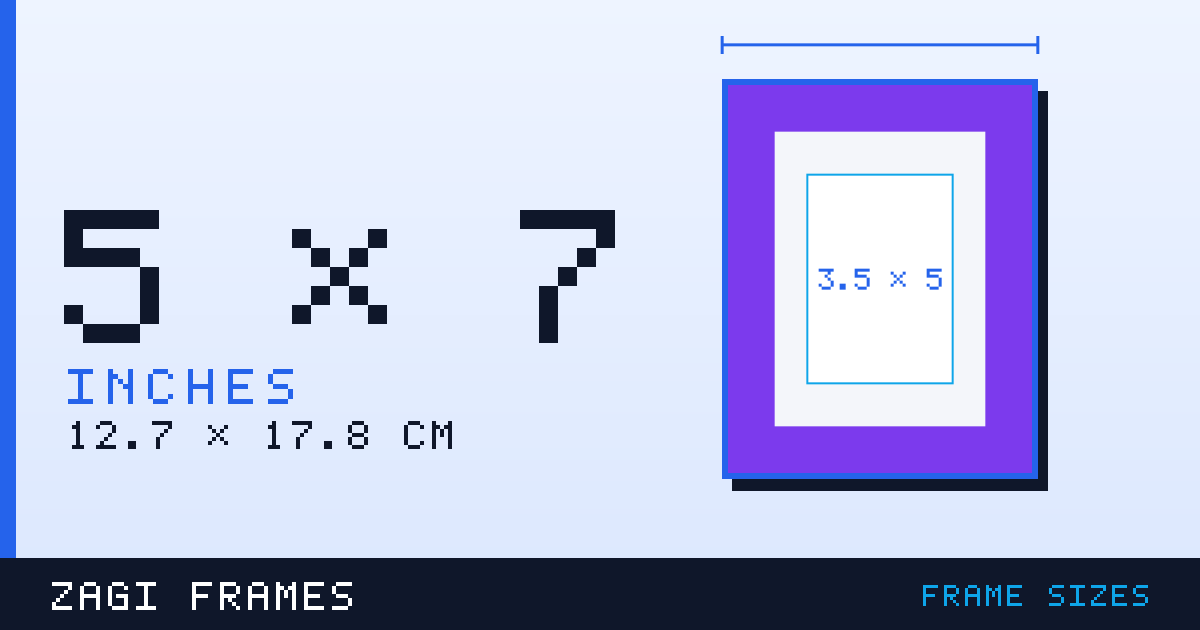
Opening: 5 x 7 inches, 12.7 x 17.8 cm, 35 square inches.
Aspect ratio: 7:5 (1:1.4).
Outside dimensions:
| Moulding width | Outside size |
|---|---|
| 0.5" | 6 x 8 |
| 0.75" | 6.5 x 8.5 |
| 1.25" | 7.5 x 9.5 |
Weight: well under a pound. A 5x7 frame is a tabletop object by weight as well as by convention.
The 4x6 trap
The most common 5x7 mistake is assuming a 4x6 photo fits one. It does not — not in any way that looks acceptable.
A 4x6 print in a bare 5x7 frame leaves half an inch of backing board visible along each side and a full inch along the top and bottom. There is nothing subtle about the result; it looks like the wrong print in the wrong frame, because it is.
The fix costs a couple of dollars: a 5x7 mat with a 4x6 opening. The mat overlaps the print by a quarter inch on each side, hides the backing entirely, and gives a half-inch border. Tight, but deliberate.
The underlying cause is the ratio difference. 4x6 is 3:2 (1.5); 5x7 is 7:5 (1.4). Printing a 3:2 file at 5x7 crops about 6.7% off the long edge, which is small enough that most people never notice and large enough to matter if something important is near the edge.
Where 5x7 works
Desks and shelves. The viewing distance is two to three feet, at which 5x7 is comfortably legible. This is what the size is for.
Table settings. Wedding table numbers, place cards, menu cards. A 5x7 card in a frame with an easel back is the standard solution, and buying twenty identical frames in one finish costs less per unit than almost any other framing purchase.
Grouped on a wall. Five or more 5x7s in matching frames, hung with consistent two-inch spacing, form a single visual element that works. The consistency does the work — mismatched small frames look like clutter rather than a collection.
Bedside and hallway shelves. Small enough not to dominate, large enough to see.
Where 5x7 does not work
Alone on a wall. A 6.5 x 8.5 inch object on an eight-foot wall reads as an accessory. If you want a single small print on a wall, mat it into an 8x10 or an 11x14 frame instead — the image stays the same size and the object gains the presence it needs.
Behind a thick mat. A 5x7 mat with a 3.5x5 opening gives a three-quarter inch border, which is about as narrow as a mat can be before it looks accidental. Matting really wants more room than this size offers.
Buying 5x7 frames
The size is inexpensive enough that people buy on appearance alone, which is reasonable. A few things still separate good from bad:
The easel back. Most 5x7 frames stand via a hinged easel. Better ones hinge from either side so the frame stands in both portrait and landscape; cheaper ones fix one orientation. If you are buying for table numbers, check this — half your frames turning out to be portrait-only is an irritating discovery on the day.
Glazing. Cheap 5x7 frames use styrene. At this size the weight saving is irrelevant and the scratch resistance of glass is worth having, since a desk frame gets handled constantly.
Consistency across a batch. If you are buying several, buy them in one order from one supplier. Nominally identical frames from different batches often differ subtly in finish, and the difference shows when they sit side by side.
Combination hanging. Frames with both an easel back and a hanging hook are more useful than either alone, and cost the same.
Grouping 5x7s well
If you are putting several on a wall, the rules that make it work:
- One finish. Mixed finishes at this scale read as clutter. Mixed sizes are fine; mixed colours are not.
- Consistent spacing. Two inches between frames, measured edge to edge, held to across the whole group.
- Align on a grid or a line. Either a proper grid, or all frames sharing a top edge or a centre line. Deliberate irregularity is very hard to pull off at this scale.
- At least five. Three 5x7s look like an oversight. Five or more look like a decision.
The gallery wall guide covers layout planning in more depth, including the paper-template method for getting spacing right before anything goes into the wall.
Materials at this size
Small frames are cheap enough that material choice is usually made on appearance, but the differences are real.
Wood is the most common and the most forgiving. At 5x7 even a soft timber is rigid enough, so pine and poplar frames perform as well as hardwood ones. The finish is what varies.
Metal — usually aluminium or a plated base metal — gives a much thinner profile than wood can at this size, which suits a desk where bulk is unwelcome. Plated finishes on cheap metal frames do wear through at the corners over years of handling.
Acrylic and lucite blocks work particularly well at 5x7. The print is clamped between two clear slabs and appears to float, there is no moulding at all, and the whole object is essentially indestructible. See acrylic and lucite frames for the details.
Silver and silver-plate frames are traditional for this size, particularly for wedding and christening photographs. Sterling silver tarnishes and needs periodic polishing; silver-plate tarnishes and eventually wears through to the base metal at the corners.
The 5x7 as a gift frame
5x7 is the default gift-framing size, and it earns that position. It is large enough for a single photograph to read properly, small enough that the recipient is not committed to finding wall space, and inexpensive enough to give without awkwardness.
Two things make a gift frame better than the average one. First, put a photograph in it — an empty frame is a task handed to someone, while a filled one is a present. Second, choose a finish that is quiet rather than decorative, because the recipient has to live with it and a plainer frame survives more rooms.
Common problems
The print curls. A 5x7 photograph in a frame with a flimsy backing bows away from the glazing over time. Cut a piece of card to the frame size and place it behind the print.
The easel collapses. Cheap easel backs are held by a friction hinge that loosens. A small piece of tape at the hinge is a passable fix; replacing the frame is the honest one.
The photo shifts. A print slightly smaller than 5x7 slides inside the frame. Two small pieces of archival tape at the top corners, attaching the print to the backing, hold it permanently without damaging it.
10 questions
Frequently asked questions
What size is a 5x7 frame?
What photo fits a 5x7 frame?
Is 5x7 a standard photo size?
Does a 4x6 photo fit a 5x7 frame?
What is the aspect ratio of a 5x7 frame?
Can 5x7 frames hang on a wall?
What size mat fits a 5x7 frame?
What frame do I need for a 5x7 print with a mat?
Are 5x7 frames good for wedding favours or table numbers?
How do 5x7 frames stand up?
Related guides
- Mini and small picture framesWallet, 2x3, 3x5 and 4x6 frames — what each holds, where they work, and how to group small frames without making a mess of a shelf.
- The 8x10 frameHow big an 8x10 frame really is on the wall, the 5x7 and 4x6 mat openings that fit it, and when to size up to a matted 11x14 instead.
- Gallery wall framesFrame size mixes that actually work, the 2–3 inch spacing rule, how to plan a grid or salon wall on paper, and hanging it straight the first time.
- Picture frame mats and mat sizesHow a mat is measured, the overlap that stops a print falling through, standard mat openings by frame size, and custom mat maths.