The 24x36 frame
24x36 is the default large poster size. Weight, glazing, moulding width and the hanging hardware a frame that big genuinely needs.
Contents · 8 sections
24x36 is the standard large frame in North America: the default poster size, a clean 2:3 photographic shape, and the largest size a general retailer reliably stocks. It is also the size at which framing stops being decoration and starts being a small engineering problem.
The numbers
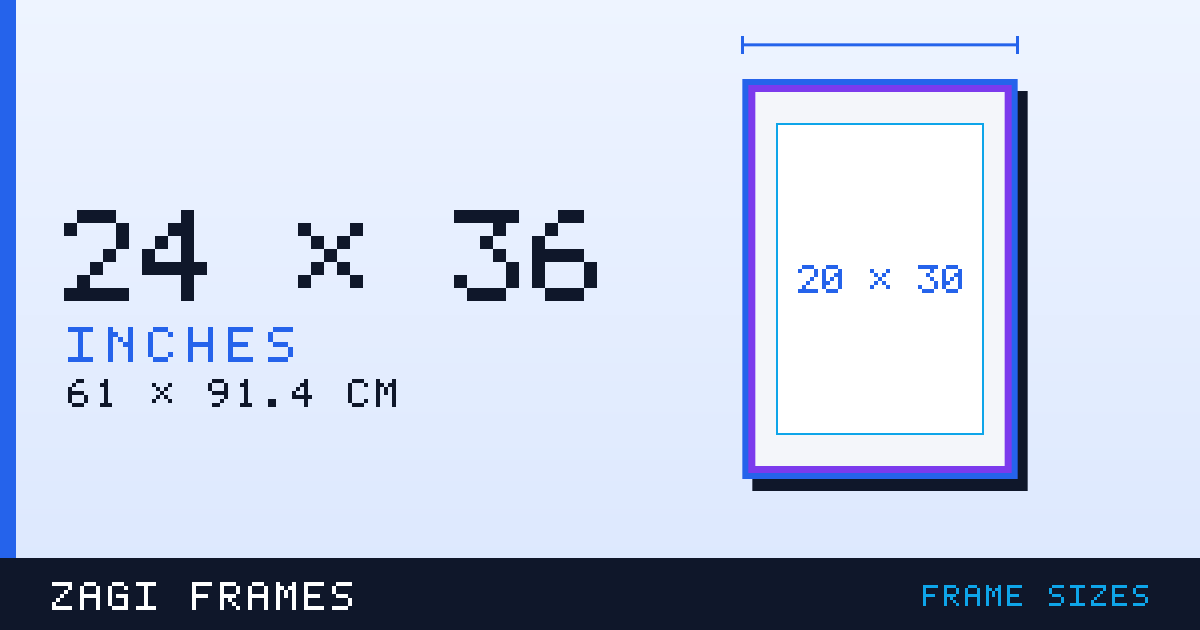
Opening: 24 x 36 inches, 61 x 91.4 cm, 864 square inches.
Outside dimensions:
| Moulding width | Outside size | Wall area |
|---|---|---|
| 0.75" | 25.5 x 37.5 | 6.6 sq ft |
| 1.25" | 26.5 x 38.5 | 7.1 sq ft |
| 2" | 28 x 40 | 7.8 sq ft |
| 3" | 30 x 42 | 8.75 sq ft |
Weight, assembled:
| Build | Weight |
|---|---|
| Aluminium section, 2mm acrylic | 5 — 6 lb |
| Wood moulding, 2mm acrylic | 6 — 8 lb |
| Wood moulding, 2mm float glass | 11 — 13 lb |
| Wide wood moulding, 3mm glass, mat | 15 — 18 lb |
That last row is the point where a badly chosen wall fixing becomes dangerous rather than merely inconvenient.
Why 2:3 matters here
24x36 is exactly the shape of a 35mm negative and of nearly every digital camera sensor. Scale a 6000 x 4000 pixel file to 36 inches on the long edge and it lands at 24 inches on the short edge with nothing to spare and nothing to crop.
That makes 24x36 the natural terminus for a photographic print run: 4x6, 8x12, 12x18, 16x24, 20x30, 24x36 all share the ratio, so the same file works at every step. Compare that with 8x10 and 16x20, which are 4:5 and force a crop on every camera file that meets them.
At 36 inches on the long edge you need 10800 pixels for a true 300 DPI print. Very few cameras deliver that. In practice a poster viewed from four feet away holds up perfectly at 150 DPI, which needs 5400 pixels — comfortably within reach of a 24-megapixel camera. Check your own file against the target in the aspect ratio calculator before ordering an enlargement.
Glazing: pick acrylic
At this size the glazing decision is not really a decision.
A 24x36 sheet of 2mm float glass weighs about 7 pounds on its own. It is awkward to carry, easy to flex, and if it breaks while you are handling a frame at arm's length above a hard floor, the pieces are large and sharp. The same sheet in 2mm acrylic weighs under 3 pounds and, if dropped, bounces.
The case for glass is scratch resistance and slightly better optical clarity. Both are real. Neither outweighs eight pounds of glass hanging above furniture where people sit. Use glass at 24x36 only when the artwork genuinely warrants it and the wall fixing is into structure.
If you do choose acrylic, buy a frame that ships with a protective film on both faces and leave it on until the moment of assembly. Acrylic attracts dust electrostatically; wipe it with a microfibre cloth and an anti-static spray, never with paper towel, which will haze it.
Matting at 24x36
Two standard pairings, and they produce very different results.
24x36 frame with a 20x30 opening. A two-inch border. Proportionally modest at this scale, which suits posters and graphic work where the image is meant to dominate.
24x36 frame with an 18x24 opening. A three-inch border at the sides and rather more top and bottom. This reads as a gallery presentation and suits art prints, etchings and photographs where you want the eye to settle before it reaches the image.
Going the other way — putting a 24x36 print in a matted frame — needs a 30x40 frame, which is a specialist purchase and takes up nearly nine square feet of wall. Worth it for a single anchor piece; excessive for anything else.
Hanging one properly
This is where 24x36 differs most from smaller frames.
Use two fixings. A single central hook lets a frame this wide rotate on the nail, and you will spend the rest of its life nudging it level. Two hooks spaced about 12 inches either side of centre hold it square permanently.
Match the fixing to the weight, with margin. For a 7-pound acrylic frame, two drywall anchors rated 20 pounds each is generous and takes ten minutes. For a 13-pound glazed frame, find a stud or use toggle bolts. Picture-hanging strips are not rated for this and will let go in warm weather.
Height. Centre of image at 57 to 60 inches. In portrait orientation the top of a 24x36 lands around 78 inches, which is above most door frames — check the wall has the height before you commit.
Bumpers. Two adhesive felt bumpers on the bottom rear corners keep the frame parallel to the wall, stop it marking the paint, and allow air behind it.
Buying at this size
Cheap 24x36 frames exist and some of them are fine. Things that separate the acceptable from the disappointing:
- Corner joints. At this size a weak mitre will open. Look for frames that are joined with V-nails or splines, not just glued and stapled.
- Backing rigidity. A flexible backing board at 24x36 bows visibly and pushes the print into the glazing. You want hardboard or a thick foam board, not corrugated card.
- Hanging hardware supplied. Many cheap large frames ship with a single sawtooth hanger, which is inadequate. Budget for D-rings and wire regardless of what is in the box.
- Whether it ships flat-packed. Some large frames arrive as four lengths to be joined at home. That is not automatically bad, but it is a different project from opening a box and hanging something.
Building one instead of buying
24x36 is the size at which ready-made frames start carrying a real premium and oversize shipping charges. Building from moulding is frequently cheaper.
Material needed in 2-inch moulding: 2 × (24 + 36) + 8 × 2 = 136 inches, plus waste — so roughly 12 feet, which means two standard sticks with a usable offcut left over.
The requirements beyond a smaller frame are a saw that will cut 36-inch stock accurately with proper support, a strap clamp long enough to span the frame, and stock at least an inch deep so the rails are rigid. Corner reinforcement is not optional at this size: use splines or V-nails, not glue alone. The step-by-step build covers the process.
Cost, relatively
| Approach | Relative cost |
|---|---|
| Retail poster frame, acrylic | 1x |
| Online frame, better moulding | 2 — 3x |
| Frame built from moulding | 1.5 — 2.5x |
| Full custom framing | 8 — 12x |
Note that building lands between the two retail options rather than below both. The saving is real but modest; the reason to build is control over the moulding and the finish.
10 questions
Frequently asked questions
What size is a 24x36 frame?
What fits in a 24x36 frame?
How heavy is a 24x36 frame?
Do I need a stud to hang a 24x36 frame?
What size mat goes in a 24x36 frame?
Is 24x36 a standard frame size?
What is 24x36 inches in centimetres?
Should a 24x36 frame use glass or acrylic?
What aspect ratio is 24x36?
How high should I hang a 24x36 frame?
Related guides
- Poster frame sizes and what they fitStandard poster frame sizes from 11x17 to 27x40, the odd sizes posters actually ship in, and how to frame a poster without trimming it.
- How to hang a picture frameHanging height, hardware by weight, drywall versus plaster, and the paper-template method that gets a gallery wall right the first time.
- Picture frame glass and acrylic glazingStandard, non-glare, UV and museum glass compared with acrylic on price, weight, clarity and protection — and when each one is the right call.
- Large picture framesPast about 24x36 a frame stops being decor and starts being engineering. Glazing, moulding, weight limits and hanging for big frames.