The 8.5x11 frame
8.5x11 frames hold letter paper, certificates and awards. Why they are rarer than 8x10, and the mat that makes an 11x14 frame do the job better.
Contents · 10 sections
8.5x11 is the document frame. It exists because US Letter paper exists, and it is the only standard frame size defined by an office supply rather than by a photographic or artistic tradition.
The numbers
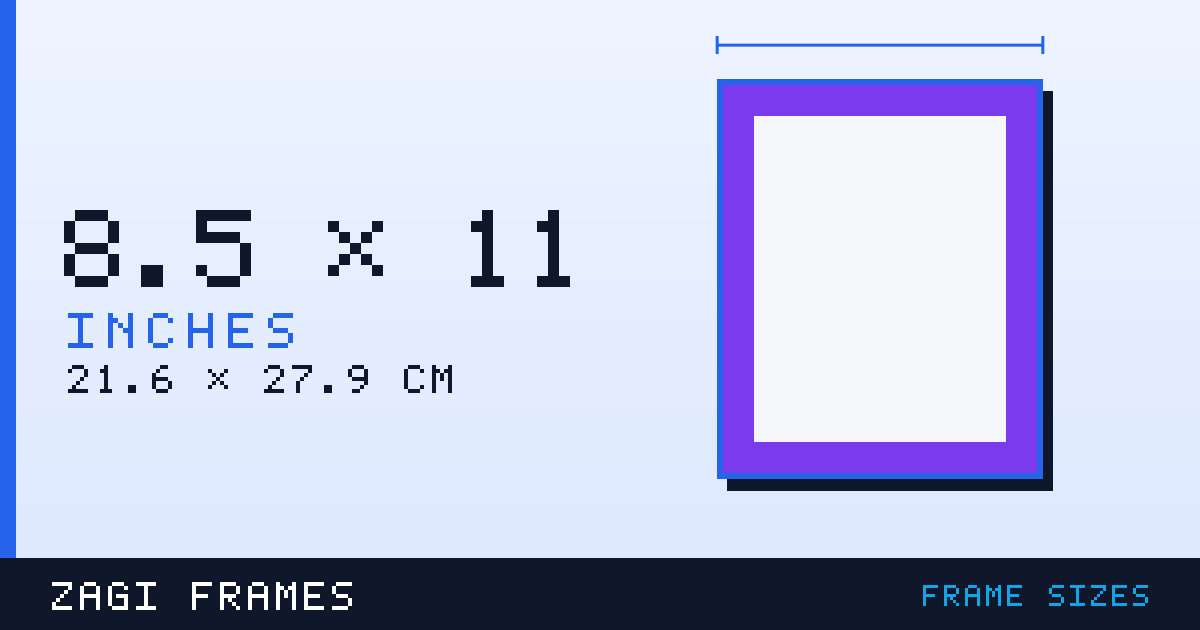
Opening: 8.5 x 11 inches, 21.6 x 27.9 cm, 93.5 square inches.
Aspect ratio: 17:22, about 1:1.294. Not a clean ratio, and shared with nothing else.
Outside dimensions:
| Moulding width | Outside size |
|---|---|
| 0.5" | 9.5 x 12 |
| 0.75" | 10 x 12.5 |
| 1.25" | 11 x 13.5 |
Weight: 1 to 2 lb. Any hook will do.
The 8x10 confusion
The most common problem with 8.5x11 is that people try to use an 8x10 frame instead, because 8x10 is the size that is always in stock.
Letter paper is half an inch wider and a full inch taller than an 8x10 opening. It does not fit, and the only way to make it fit is to trim it — which on a certificate, a diploma or anything with a signature is an irreversible mistake.
If an 8.5x11 frame is not available, the correct substitute is an 11x14 frame with an 8.5x11 mat opening. That is a better result than a bare 8.5x11 frame in almost every respect, and 11x14 frames are stocked everywhere.
The A4 near-miss
A4 is 8.27 x 11.69 inches. Against 8.5x11 that is:
- 0.23 inches narrower — the sheet is loose in the frame
- 0.69 inches taller — the sheet does not fit at all
This catches people constantly with certificates issued outside the United States, and with art prints bought from European sellers. A4 in an 8.5x11 frame is not a tight fit; it is an impossible one in the vertical direction.
Buy an A4 frame, or use an 11x14 frame with a custom A4 mat opening. The full set of near-misses between the two systems is in the metric frame sizes guide.
Framing documents properly
Documents have requirements that photographs do not.
Mat them. Not primarily for looks, though it helps. Paper pressed against glazing will bond to it in humid conditions, and separating a certificate from glass without destroying it is a conservation job. A mat creates the air gap that prevents it outright.
The conventional treatment is a mat with an 8.5x11 opening in an 11x14 frame, giving a 1.25 inch border. That is narrower than you would use for artwork, and correctly so — documents already have generous printed margins, and a wide mat on top of them starts to look ceremonial.
Use UV glazing. Documents hang in offices, corridors and studies, often opposite windows, for decades. That is the exact recipe for fading: printed inks lose density, coloured seals shift, and paper yellows unevenly where a mat has shielded part of it. UV-filtering acrylic blocks 97% or more of ultraviolet and costs modestly more than plain glazing. It is the single most worthwhile upgrade for anything you cannot reprint.
Hinge, do not glue. Attach the document with archival hinging tape or photo corners along the top edge only, so it can expand and contract with humidity. Taping all four edges causes buckling. Ordinary household tape yellows, hardens and stains through the paper within a few years.
Never dry-mount an original. Dry-mounting bonds a document permanently to a board. It gives a flat result and it is irreversible. Acceptable for a photocopy; never for a signed or sealed original.
Multi-document arrangements
Two or three certificates in one frame is a common request. Two arrangements work.
Stacked vertically for documents of different importance, with the more significant one above. This is the easier arrangement to hang and takes less wall.
Side by side for equal documents. It needs a wide wall — two 8.5x11 openings with proper borders puts the frame at roughly 22 x 16 inches.
In both cases, leave more mat between the openings than around the outside, or the two documents read as one crowded block. Two to three inches between openings is the working figure. The diploma framing guide covers double and triple layouts in more detail, along with name plates and tassels.
Buying an 8.5x11 frame
Check the actual opening. Some frames marketed as "certificate frames" have an 8x10 opening with an 8.5x11 outside size. Read the specification, not the marketing.
Look for D-rings on both sides. Many document frames ship with a single fixed hanger that locks the orientation. Certificates are usually portrait, but not always, and awards frequently are not.
Check the glazing. Office-supply document frames often use very thin styrene. For anything you intend to keep, replace it with acrylic or, better, buy a frame with proper glazing to start with.
Consider depth. If you might add a name plate or a second mat later, a rabbet of at least three eighths of an inch gives you room to change your mind.
When 8.5x11 is the wrong choice
If the document matters — a degree, a professional certification, a commission — an 8.5x11 frame is the minimum viable option rather than the right one. The document sits tight against the frame edge with nothing to breathe, and the presentation reads as functional rather than considered.
The better answer, for perhaps five dollars more, is an 11x14 frame with an 8.5x11 mat. It is the same document, in a frame that treats it as though it mattered.
Landscape orientation
Awards, licences and some certificates are printed landscape — 11 inches wide by 8.5 tall. Most 8.5x11 frames are designed and hung portrait, and many ship with a single fixed hanger on one edge.
Check for D-rings on both pairs of sides before buying, or plan to fit them yourself. It takes five minutes with a bradawl and a screwdriver and makes the frame usable either way permanently.
If you are buying several frames for a mixed set of documents, buy frames with wire hanging rather than sawtooth hangers for exactly this reason.
Multiple documents on a wall
Professional certifications tend to accumulate, and a wall of them is a common framing project.
Two approaches work. Identical frames in a grid — three across, two down, with two-inch gaps — is the simplest and always looks intentional. A single large frame with multiple openings puts several documents behind one mat and takes considerably less wall.
Either way, consistency does the work. Matching frames, matching mats and consistent spacing make a group of unrelated documents read as a deliberate display. Mixed frames make the same documents read as accumulation. The gallery wall guide covers layout and spacing in detail.
What it costs
An 8.5x11 frame is inexpensive. Adding a custom-cut mat roughly doubles or triples that, and adding UV-filtering glazing adds more again.
For a document that will hang for thirty years, both upgrades are worth it and together still cost less than a modest meal. For a temporary certificate, a plain frame is entirely reasonable. The judgement is simply whether the document can be reprinted.
10 questions
Frequently asked questions
What size is an 8.5x11 frame?
Is 8.5x11 a standard frame size?
Can I put an 8.5x11 document in an 8x10 frame?
What is the aspect ratio of 8.5x11?
Does A4 fit an 8.5x11 frame?
What frame do I need for an 8.5x11 certificate with a mat?
Should certificates be framed with a mat?
What glazing is best for a document frame?
Can I use an 8.5x11 frame in landscape?
Why are 8.5x11 frames less common than 8x10?
Related guides
- Diploma and graduation framesDiploma frame sizes by school, how to measure a certificate before you buy, double-diploma layouts, and why diploma frames cost what they do.
- The 11x14 frame, measured properlyWhat an 11x14 frame actually holds, the mat openings that turn it into an 8x10 or 8.5x11 display, and how to buy one that fits.
- The 8x10 frameHow big an 8x10 frame really is on the wall, the 5x7 and 4x6 mat openings that fit it, and when to size up to a matted 11x14 instead.
- Picture frame mats and mat sizesHow a mat is measured, the overlap that stops a print falling through, standard mat openings by frame size, and custom mat maths.