The 11x14 frame, measured properly
What an 11x14 frame actually holds, the mat openings that turn it into an 8x10 or 8.5x11 display, and how to buy one that fits.
Contents · 6 sections
If you keep one spare frame size in a cupboard, make it 11x14. It is the most versatile frame in general retail: it takes an 11x14 print at full bleed, an 8x10 behind a mat, an 8.5x11 certificate, or a 9x12 sheet of art paper. Very few sizes do four jobs.
The measurements
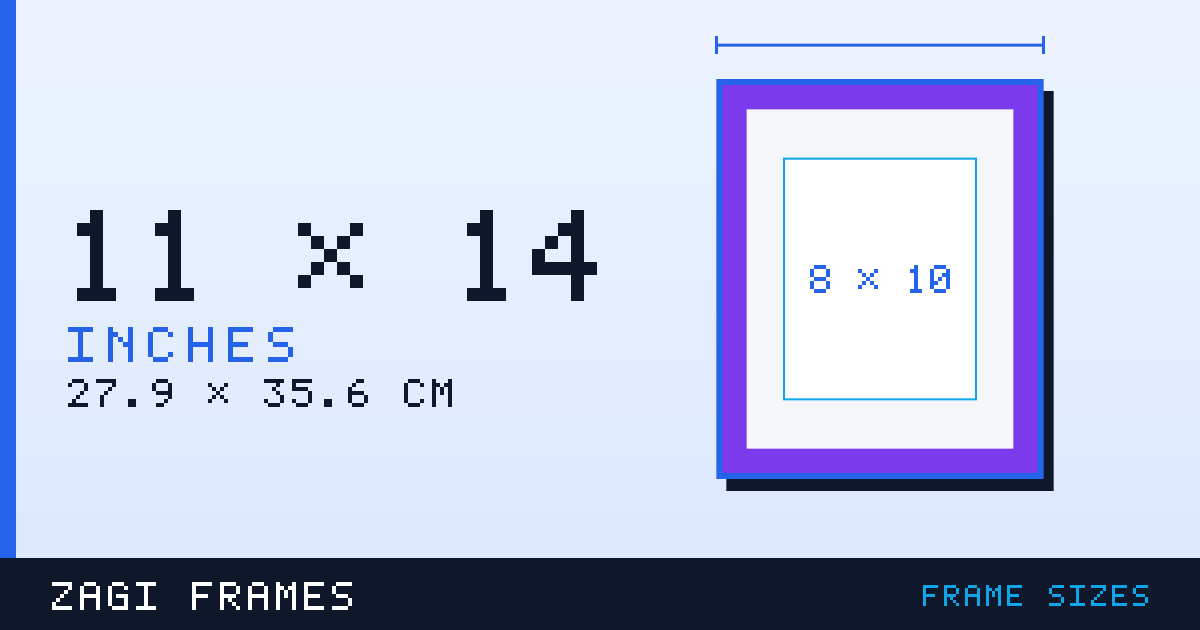
Artwork opening: 11 x 14 inches, or 27.9 x 35.6 cm.
Rabbet: typically 11.125 x 14.125 inches — an eighth of an inch of clearance in each direction so the contents drop in without binding.
Area: 154 square inches. Worth stating because people underestimate it. An 11x14 is nearly twice the area of an 8x10, not a slight increase.
Outside dimensions, which is what the wall actually gives up:
| Moulding face width | Outside size |
|---|---|
| 0.5" minimal | 12 x 15 |
| 0.75" narrow | 12.5 x 15.5 |
| 1.25" standard | 13.5 x 16.5 |
| 2" gallery | 15 x 18 |
| 3" ornate | 17 x 20 |
Weight, assembled, with the usual materials:
- Wood moulding, 2mm float glass, 4-ply mat, MDF backing: roughly 2.5 to 3 lb
- The same frame with acrylic instead of glass: roughly 1.6 to 2 lb
- Aluminium section with acrylic: under 1.5 lb
All of these hang safely from a single picture hook into drywall. You do not need a stud, an anchor or a wire at this size — though a wire distributes load better and lets you nudge the frame level, which matters more day to day than the weight rating does.
What fits, and how
An 11x14 print, unmatted
The straightforward case. The print fills the opening, the rabbet overlaps its outer eighth of an inch on each side, and nothing is visible but the image. Use this when the image is meant to run to the edge — photographic prints of landscapes, posters, reproductions where a border would fight the composition.
The risk is that any inaccuracy in the print cut shows. A print trimmed to 10.9 inches wide leaves a hairline gap on one side that your eye will find every single time you walk past. If you are printing at home, cut generously and trim to fit rather than the other way round.
An 8x10 behind a mat
The most common use of this frame, and the reason it is stocked as heavily as it is. An 11x14 mat with an 8x10 opening cuts a hole of about 7.5 x 9.5 inches, overlapping the print by a quarter of an inch on each side. That leaves a visible border of roughly 1.5 inches at the sides and 2 inches top and bottom on a weighted mat.
Ready-made mats in this combination cost very little, come in white, off-white, black and a handful of colours, and turn a mass-market frame into something that looks considered. If you buy one accessory for a frame, buy this one.
An 8.5x11 document
Letter-size certificates and documents fit an 11x14 frame with a mat cut for 8.5x11. The resulting border is narrower — about 1.25 inches — which suits documents, where a wide mat starts to look like an award ceremony. This is a much better solution than an 8.5x11 frame, which pins the document to the frame edge with nothing to breathe.
A 9x12 sheet
Art paper pads come in 9x12, and an 11x14 frame with a 9x12 opening gives a one-inch border. Tight, but acceptable for studies and sketches where you want to keep the frame small. For finished work, step up to a 12x16 frame instead.
The ratio problem, honestly
11x14 reduces to a ratio of about 1:1.273. Nothing else in the standard size list shares it. 8x10 is 1:1.25, which is close but not equal.
In practice this matters in exactly one situation: printing an image to fill an 11x14 frame edge to edge from a file composed for 8x10. Scaled to 11 inches wide, an 8x10 image is 13.75 inches tall — a quarter inch short of the opening. You will either see the backing board along one edge or you will crop.
Matting removes the problem entirely, which is the honest argument for matting almost everything at this size. Check your own dimensions in the aspect ratio calculator before ordering a print if you intend to go full-bleed.
Buying an 11x14
Because the size is so common, the quality spread is enormous. Five things are worth checking before you commit.
Glazing. Cheap frames at this size ship with thin styrene rather than glass or proper acrylic. Styrene scratches if you look at it wrongly and yellows within a few years. Glass or true acrylic is a meaningful upgrade and is usually identifiable from weight alone.
Backing. A stiff MDF or hardboard back holds artwork flat. A flexible card back lets it bow, and a bowed print touching glass will eventually stick to it.
Corners. Look at the mitres from the front. Gaps at the corners on a brand-new frame mean the joins were not properly clamped, and they will open further as humidity changes.
Hanging hardware. Sawtooth hangers are acceptable at this size but allow only one hanging position and cannot be levelled. D-rings and wire cost pennies more and are worth swapping in.
Depth. If you plan to mat, check the rabbet is deep enough for glazing plus mat plus artwork plus backing — about a quarter of an inch in total. Very slim decorative frames are not.
When not to use 11x14
If the artwork is itself 11x14 and you want it matted, you need a 16x20 frame, not this one. If the artwork is a poster, 11x14 is too small to read as anything but a postcard on most walls. And if you are building a gallery wall of mixed sizes, 11x14 works best as the repeating mid-size element rather than the largest piece — it does not have the presence to anchor a wall on its own.
Resolution at 11x14
A 300 DPI print needs 3300 x 4200 pixels — 13.9 megapixels. At 200 DPI, adequate for wall viewing, it needs 2200 x 2800, or 6.2 megapixels. Almost any modern file clears the second figure comfortably.
10 questions
Frequently asked questions
Is 11x14 a standard frame size?
What size picture fits in an 11x14 frame?
What size mat do I need for an 11x14 frame?
How big is an 11x14 frame on the wall?
Is 11x14 bigger than 8x10?
What aspect ratio is an 11x14 frame?
Can I put an 8x10 photo in an 11x14 frame?
What size frame do I need for an 11x14 print with a mat?
How heavy is an 11x14 frame?
Why is 11x14 so common?
Related guides
- The 8x10 frameHow big an 8x10 frame really is on the wall, the 5x7 and 4x6 mat openings that fit it, and when to size up to a matted 11x14 instead.
- The 16x20 frame16x20 is the most useful mid-size frame there is: it takes an 11x14 mat, a 12x16 print or a full-bleed 16x20 canvas. Here are the numbers.
- Picture frame mats and mat sizesHow a mat is measured, the overlap that stops a print falling through, standard mat openings by frame size, and custom mat maths.
- Standard picture frame sizes explainedEvery standard picture frame size in inches and centimetres, which print each one fits, and how matting changes the frame size you need to buy.